


Pohle E-Z-GO Cushman
Authorized E-Z-GO dealer Authorized Cushman dealer

Brands that came, and went

Golf carts have been sold in America since the 1950s. This list runs in order of when each brand arrived. In that time dozens of brands have appeared, taken people’s money, and disappeared. Some were household names. Harley-Davidson sold golf carts for nineteen years. Westinghouse sold them. Toro planned to build a thousand, built 250, and quit.

Every one of those companies had a factory, a dealer network and a warranty. Today nobody can get you a part for any of them.

30brands on this page are gone
1954E-Z-GO started, and never stopped
1901Cushman started, and never stopped
BrandSold in the USStatusNotes
Cushman1901–Still tradingWe sell it. Manufactured in Augusta, GA, USA
Columbia Par Car1946–Changed handsNow marketed under Tomberlin
Taylor-Dunn1949–Left the cart marketBought by Polaris; industrial vehicles now
Electric Shopper1950s–60sGoneOne of the earliest electrics
Elektro1950s–60sGoneVintage parts only
Hoffman1950s–60sGoneVintage parts only
Motorette1950s–60sGoneVintage parts only
Ride Around / Turf Rider1950s–mid 1960sGoneHawthorne, California
Tripcoe Tee Birdie1950s–60sGoneVintage parts only
Walker Executive1950s–60sGoneVintage parts only
Westmont1950s–60sGoneVintage parts only
E-Z-GO1954–Still tradingWe sell it. Manufactured in Augusta, GA, USA
Western1957–1985GoneTwenty-eight years
Club Car1958–Still tradingOne of the big three
Marketeer1959–1982GoneTwenty-three years
Nordskog1959–1980sGoneLater merged into US Electricar
Allis-Chalmers1960sGoneFarm-equipment maker; brief cart line
Capri1960sGoneSmall US builder
Davis1960s–70sGoneVintage parts only
Jacobsen1960s–70sGoneTurf equipment maker
Karrior1960sGoneVintage parts only
Otis1960s–80sGoneVintage parts only
Tomberlin1960s–Still tradingAbsorbed Columbia Par Car
Toro “Golfmaster”early 1960s–1966GonePlanned 1,000 units. Built 250. Quit
Westinghouse1960sGoneHousehold name. Exited anyway
Harley-Davidson1963–1982GoneYes, that Harley. Nineteen years, then out
Pargo1965–1976GoneIts dealers started their own brands
Noland1970s–90sGoneBuilt Walt Disney World’s fleet
Yamaha1970–Still tradingOne of the big three
Melex1971–Still tradingPolish-built
Legend1980s–90sGoneVintage parts only
US Electricar1980s–90sGoneAbsorbed Nordskog
Hyundaiapprox. 1990–1995GoneShort-lived US cart line
Ruff & Tuff2000s–2010sGoneOwners told to look for E-Z-GO parts that fit
STAR EV2003–Still tradingContainerized import — Guangdong Marshell Electric Vehicle (bill of lading, Feb 2025)
Fairplay2005–2011GoneUS Customs and Border Protection issued a country-of-origin final determination on Fairplay Electric Cars, LLC in 2010 (Customs Bulletin vol. 45 no. 2). Per that ruling, Fairplay imported chassis, plastic body parts and trim from China and assembled them in the United States. Renamed twice, then sold
Evergreen Electric Vehicles2011–2012GoneFairplay Electric Cars renamed. Assembly moved to Long Beach, California. Lasted about a year
Evolution EV2011–Still tradingContainerized import — Xiamen Dalle New Energy Automobile; Xiamen Triquality Supply Chain (likely a forwarder, not a factory). Records found run 2020–2022 only; US address moved from Chino to Ontario to Corona, California, then to Ocala, Florida
Legacy2011–2012GoneThird name for the Fairplay line. CBP issued a separate determination concerning Fairplay Legacy Electric Vehicles
Bintelli2015–Still tradingContainerized import — Dongguan Excar Electric Vehicle (Mar 2025); Alwayz Electric Vehicle (Chuzhou), same as Vivid EV (Sep 2024); Zhejiang Overfly Electric Vehicle (Sep 2024)
ICON EV2017–Still tradingContainerized import — Guangdong Lvtong New Energy (bills of lading, Dec 2024)
Kandi2019–Still tradingUS arm is SC Autosports LLC, dba Kandi America, a wholly owned subsidiary of Kandi Technologies Group Inc. (NASDAQ: KNDI), Jinhua, Zhejiang, China. Began assembling carts in Garland, Texas in May 2025
Vivid EV2019–Still tradingContainerized import — Alwayz Electric Vehicle (Chuzhou), same as Bintelli (Dec 2024); Shenzhen Aoxiang Industries (likely a forwarder, not a factory)
Advanced EV2020–Still tradingContainerized import. CPSC recall notice (May 2023) names the importer as LvTong USA Golf Cars LLC, dba Advanced EV, of Dallas, Texas, and the carts as manufactured in China
Colemanapprox. 2021–2025GoneBuilt by Kandi; Lowe’s cleared them out nationwide in 2025
Denago EV2022–Still tradingContainerized import — Zhejiang Taotao Vehicles (bill of lading, Dec 2024)

A grain of salt. As best we can tell these dates are accurate, but take them with a grain of salt. Some of these companies changed hands three times before they folded, and a few of the older ones left almost no record at all. The important take-away is not the exact year. It is that they were here for a bit, and now they are gone, and no one has parts, and no one can service them. Stick with the tried and true to avoid heartache and wasting money.

About the import records. Where we name a Chinese supplier, that comes from United States Customs bills of lading, which are public record. Those entries are accurate as of 2026 and may change. Brands switch factories, sometimes more than once a year, so a supplier listed here may not be the one building that brand’s carts today.

Ask one question before you buy anything. Who fixes it in ten years? If the answer is a website, a phone number in another state, or a badge nobody recognises, you already know how this ends. We have been at the same job in Arizona since 1983, and we stock parts for E-Z-GO carts built twenty years ago.

Show me the good stuff

Great questions we get every week.

8/20/2026
It depends on whether you're replacing lead-acid or moving to lithium, and on pack size. A full lithium conversion of a late-model EZGO RXV using the factory Samsung drop-in system, with 8-year warranty, runs about $4k-5k all-in, including harnesses, power assembly, state-of-charge meter, and a dedicated matched charger. The majority of the electrical system is replaced to do the job right. You'll find quotes from mobile converters, "battery guys", for far less money but those are often cheap systems off Amazon or other e-retailers and the after-sale support is apparently abysmal based on the calls for help we get. We have learned never to work on those aftermarket nightmare conversions so we'll listen empathetically but all we can offer is a verbal hug when those systems fail. Lead-acid replacement costs less up front but will need repeating within 2-4 years depending the diligence of your watering maintenance and the heat loads experienced in our AZ sun. See our batteries page or call your nearest store for a current quote. https://pohlenv.com/Batteries.aspx
8/20/2026
The best value is rarely the cheapest sticker price. Add up what you'll spend over five to ten years: the cart, batteries, service, and parts. A well-built cart from an established brand usually costs less over its life than a bargain cart that spends months waiting on a component. And often the cheap import brand is no longer even imported once you need parts. The dealer who sold you the cart shrugs his shoulders and shows you his new brand of imports. We hear this everyday. Our certified pre-owned rebuilds are often the sweet spot in Value - a proven American-built chassis gone through tires-to-top at a fraction of new-cart pricing. https://pohlenv.com/Fleet-Car-Inventory-Lithium.aspx
8/20/2026
Plenty of Arizona residents do, especially in golf and retirement communities where trips are short and roads are slow. To do it legally on public streets you'll need the cart properly equipped, registered, and insured, with a licensed driver. Range is the practical limit, so match the pack to your typical day - our lithium packs range from about 25 miles up to about 45 miles depending on size. Check local ordinances too, since where you can drive varies by city.
8/20/2026
Yes, when you're on a public roadway. Arizona has specific rules for carts, including A.R.S. 28-777, which requires golf cart and neighborhood electric vehicle drivers to yield the right-of-way to vehicles traveling the same direction that intend to turn right. A.R.S. 28-904 also prohibits driving a vehicle on a sidewalk except at a driveway. Local jurisdictions add their own rules about designated cart routes and crossings. https://www.azleg.gov/ars/28/00777.htm
8/20/2026
Charge it correctly, keep batteries clean and watered if they're lead-acid, check tire pressure, and have it serviced annually or more often if you drive a lot. Clean terminals about once a month with baking soda and water, and keep water away from the speed controller. DOT street tires max out at 35 psi; turf tires at 22 psi. Lithium carts skip the battery maintenance entirely - see our service page for our recommended annual schedule. https://pohlenv.com/Service.aspx
8/20/2026
The most frequent issues are a charger that won't turn on, reduced range, corroded cables, and low tire pressure. If your charger won't start, try plugging it in again, check for loose or corroded cables, and verify the wall outlet and breaker. Many modern chargers activate from battery power rather than wall power, so a cart that's sat for three weeks or more may need a jump from a smaller charger first. Bring it to any of our stores if that doesn't solve it. https://pohlenv.com/Store-Locations.aspx
8/20/2026
Slow down before turns - carts have a high center of gravity and tip more easily than a car. Keep arms and legs inside, never let passengers ride standing or hanging off the back, and be extra careful on slopes and loose surfaces. Set the parking brake every time you stop on a grade. If children ride with you, seat belts are worth adding even though Arizona doesn't require them on golf cars.
8/20/2026
Standard turf tires do poorly in soft sand, and salt air and salt water are hard on the frame, electrical connections, and fasteners. If you need sand capability, look for a lifted cart with proper all-terrain tires and plan on rinsing thoroughly after every outing. For most Arizona owners this comes up on dirt and washes rather than beaches, and the same tire advice applies.
8/20/2026
You want strong low-end torque, good brakes, and enough capacity that climbing doesn't drain you before you get home. E-Z-GO's ELiTE series offers a 90 amp-hour pack rated around 32 miles and a 120 amp-hour pack rated around 45 miles, both good choices for hills. Regenerative braking recaptures some of the energy you spend climbing. Tell us about your terrain through our service page and we'll size the pack correctly the first time. https://pohlenv.com/Service.aspx
8/20/2026
Turf tires are designed for grass and are gentle on courses, max 22 psi. DOT street-rated tires are built for pavement and neighborhood driving, max 35 psi. All-terrain tires handle dirt, gravel, and washes but wear faster on pavement and run noisier. Correct pressure matters more than most people think - it affects rolling resistance, battery range, and steering effort. Ask about tire options through our accessories page. https://pohlenv.com/Accessories.aspx
8/20/2026
The most requested are rear seat kits, upgraded 12-inch or 14-inch wheels with DOT tires, tinted wrap-around windshields, LED light kits with turn signals, and custom seating. Comfort add-ons like coolers, front accessory trays, club and ball washers, and enclosures for cool mornings are also popular. If you're adding 12-volt accessories, make sure your installer uses a proper 48V-to-12V converter rather than piggybacking off a single battery - that shortens the life of the whole pack. See our full accessories catalog for current options. https://pohlenv.com/Accessories.aspx
8/20/2026
At minimum, working headlights, tail lights, brake lights, turn signals, a horn, and a mirror if you plan to drive on streets. A good windshield keeps wind, bugs, and rocks out of your face. Retractable seat belts and hand rails are worth considering, especially with children or older passengers, even though Arizona doesn't require seat belts on golf cars. Good brakes and correct tire pressure do more for your safety than any accessory.
8/20/2026
Electric carts are quiet, produce no fumes, accelerate smoothly, and have fewer moving parts to maintain. Gas carts offer much greater range on a tank and are simpler to store for long stretches, which winter visitors appreciate. Cost of ownership over the life of the vehicle isn't very different. Electric is the more popular choice nationally, and some Arizona communities don't allow gas carts on the course - check your local rules first.
8/20/2026
For most owners, yes. Lithium packs need no watering and no maintenance, weigh over 250 pounds less than lead-acid, charge in about half the time, and hold performance instead of fading as they age. E-Z-GO's ELiTE series uses Samsung SDI lithium technology and carries an 8-year battery warranty for consumer use. The trade-off is a higher price up front, which many owners recoup through zero maintenance and longer service life. See our batteries page for warranty details and current pricing. https://pohlenv.com/Batteries.aspx
8/20/2026
Charge after every use once you've gone more than about five miles, and let the automatic charger finish its full cycle rather than unplugging early. For lead-acid, keep water at the proper level, add water after charging rather than before, and clean terminals about once a month with baking soda and water. Keep the cart in neutral when parked - that stops current flow better than the key switch alone. If it's going to sit, charge it every three weeks or so.
8/20/2026
The most common signs of a failing pack are shorter range, sluggish performance on hills, and a charger that won't turn on. Many modern chargers are activated by battery voltage rather than wall power, so a deeply discharged pack can leave the charger dead. Corroded or loose cables cause a surprising number of problems and are cheap to fix. If your range has dropped noticeably, schedule service before you get stranded. https://pohlenv.com/Service.aspx
8/20/2026
It depends on how the cart is equipped and where you plan to drive. Under A.R.S. 28-2153, a golf cart used in the operation of a golf course, or only incidentally operated or moved on a highway, is exempt from registration. Once you're using a cart for regular travel on public roads, expect registration, insurance, proper equipment, and a licensed driver to apply. Rules also vary by city, county, and HOA, so check your local jurisdiction for your specific streets. https://www.azleg.gov/ars/28/02153.htm
8/20/2026
Yes, if you drive it on public roadways. The Arizona Department of Transportation states that the mandatory insurance requirement covers every motor vehicle operated on roadways and specifically includes golf carts. Current minimums are $25,000 bodily injury for one person, $50,000 for two or more people, and $15,000 property damage. Call your agent to add the cart to your policy or write a separate one. https://azdot.gov/faq/what-mandatory-insurance
8/20/2026
Arizona law defines a golf cart in A.R.S. 28-101 as a motor vehicle with at least three wheels on the ground, unladen weight under 1,800 pounds, designed and operated at not more than 25 mph, carrying no more than four people including the driver. A low-speed vehicle, or LSV, is a federal category under 49 C.F.R. 571.500 that requires safety equipment like seat belts, windshields, turn signals, headlights, and brake lights. In plain terms, an LSV is built and certified from the factory for road use, while a golf cart may or may not be equipped for it. If road use is your plan, tell us up front so we put you in the right vehicle. https://www.azleg.gov/ars/28/00101.htm
8/20/2026
This is more about standards and safety than horsepower. The U.S. standard for a golf cart used on a course is 12 to 14 mph, and a cart equipped with lights, top, windshield, and mirror is rated at 20 mph. Low-speed vehicles top out at 25 mph. Our street-legal rebuilds typically run 19 to 24 mph. Take a test drive before paying extra for top speed - a golf cart feels very different from a car.
8/20/2026
Price depends on new versus used, battery type, seating capacity, and equipment, so the range is wide. Our fully serviced lithium carts start as low as $4,500 with factory warranty, and new carts with the latest options run considerably more. The best way to get a real number is our current inventory online - every car is listed with its own price, specs, and amp-hours. https://pohlenv.com/All-Car-Inventory.aspx
8/20/2026
We offer financing and leasing on new, certified pre-owned, and pre-owned cars through Sheffield Financial, subject to credit approval. There's a $125 processing fee and a $1,500 minimum purchase requirement, and promotional terms change from time to time. Leasing can make sense for commercial users who want predictable costs and fresh equipment. See our Financing page for current program rules. https://pohlenv.com/Financing.aspx
8/20/2026
For a single weekend or event, renting almost always wins. If you'll use it regularly, buying usually pays off within a season or two, and you keep an asset that holds value. Run the math on how many days per year you expect to use it. For most Arizona residents in a golf or retirement community, ownership pays off quickly because the cart gets used year-round.
8/20/2026
For an electric cart with lead-acid batteries, your ongoing costs are watering supplies, an annual service, brakes and tires as they wear, and eventually a battery pack. Lithium cuts that list down considerably because the batteries need no maintenance at all. Gas carts add oil changes, filters, and fuel. We recommend an annual service for any cart - see our service page for what's included. https://pohlenv.com/Service.aspx
8/20/2026
A reputable brand has a real factory, a real warranty, and a real parts network - and has had all three for a long time. Watch for brands that appear, disappear, and come back under a new name right when owners need warranty support. Check where a cart is actually built, since some imported carts arrive in shipping containers and get their tops, windshields, and brand labels installed here before being marketed as American-made. Public import records are online if you want to check for yourself.
8/20/2026
Commercial work is hard on a vehicle, so look for a heavy-duty frame, real payload and towing ratings, and a service network that gets you running fast when downtime costs money. Cushman builds specifically for this, with utility models rated to haul serious payloads. Confirm the commercial warranty terms too - they're usually shorter than consumer terms. E-Z-GO's lithium battery warranty, for example, is 5 years commercial versus 8 years consumer. Browse our utility and commercial inventory to see current models and payload ratings. https://pohlenv.com/Passenger-Utility-Vehicle-Inventory.aspx
8/20/2026
New gets you the full factory warranty, the latest battery technology, and exactly the colors and options you want - but you take the biggest hit on depreciation. Used costs less up front and lets someone else absorb that first drop in value, though you inherit whatever wear is already there. Certified pre-owned sits in the middle, and it's where a lot of our customers land. https://pohlenv.com/Fleet-Car-Inventory-Lithium.aspx
8/20/2026
Look for an established American-built brand with a straightforward electrical system and parts you can still get. Off-lease fleet carts are the best-kept secret in used carts, because golf courses maintain them on a strict schedule and turn them over on a set cycle. We rebuild these tires-to-top with new batteries and cables, fresh or repainted bodies, and updated wheels and tires. That's a known-history vehicle at a used-cart price. https://pohlenv.com/Used-Car-Inventory.aspx
8/20/2026
Check battery age and condition first - that's the most expensive thing to replace. Then look at the frame for rust or acid damage around the battery tray, test the brakes, and drive it up an incline to see whether it pulls strongly or fades. Ask for the amp-hour reading, which is the golf cart equivalent of an odometer. We publish amp-hours on every car on our website for exactly this reason, and we wish every dealer did.
8/20/2026
Get three numbers: the amp-hour reading, the age of the battery pack, and the year of the cart. As a rough guide, around 15,000 amp-hours is prime of life, 35,000 is a solid rebuild candidate, and 60,000 means it's been worked hard and should be priced accordingly. If the seller can't tell you the battery age, assume you're buying batteries soon and negotiate from there. And if a body looks brand new on an older chassis, ask what else was done - a new body on a tired cart is an old trick.
8/20/2026
Well-maintained carts from established brands hold value reasonably well, especially in Arizona where the season is long and demand is steady. Battery condition drives resale more than almost anything else, so a healthy pack is worth substantially more than the same cart with a tired one. Brands with shaky parts support fall off hardest, because buyers know they may not be able to service them.
8/20/2026
Start with how many people you actually carry on a typical trip, not the maximum you can imagine. Two-passenger carts are compact and easy to store, four-passenger models handle most families, and six- and eight-passenger models are built for groups and neighborhood cruising. Longer carts need more garage space and a wider turning radius. We carry two, four, six, and eight passenger models - see our multi-passenger inventory or come sit in a few. https://pohlenv.com/Multi-Passenger-Car-Inventory.aspx
8/20/2026
A four- or six-passenger model with a rear seat, seat belts, and a good top usually makes the most sense. Look at a flip-flop or 2+2 rear seat if you want to switch between passengers and cargo. Add a windshield for wind and bug protection, and consider a cooler mount for Arizona afternoons. Check our accessories page for options. https://pohlenv.com/Accessories.aspx
8/20/2026
Look for easy entry and exit, comfortable seating, a smooth ride, and a top and windshield for sun protection - which matters a lot here. Lithium models are especially popular because there's no battery watering and no maintenance to keep up with. Many communities also expect street-legal equipment like lights, turn signals, mirrors, and a horn. We've served Sun City and Sun City West for decades and know what these communities require.
8/20/2026
Resorts need carts that run all day, handle constant passenger turnover, and are simple for staff to maintain. Fleet-grade models from established manufacturers are built for this duty cycle, and lithium packs charge fast and need no watering. Plan for enough charging infrastructure - that's usually what limits a resort fleet, not the carts. Call us and we can help spec a fleet order. https://pohlenv.com/Passenger-Utility-Vehicle-Inventory.aspx
8/20/2026
Look for a dealer that stocks parts locally, does its own service work, has been around long enough to still be there for your warranty, and will talk straight about what you actually need. Reviews help, but so does walking in and asking hard questions about parts availability and turnaround. Pohle has served Arizona since 1983 with locations in Scottsdale, Mesa, Sun City, Sun City West, and Tucson, plus free Phoenix and Tucson metro delivery and nationwide shipping. See our store locations and hours. https://pohlenv.com/Store-Locations.aspx
8/20/2026
Reliability comes down to three things: how the cart is built, whether parts are on the shelf when you need them, and whether the brand will still exist in five years. E-Z-GO has been built in the USA since 1954 and Cushman since 1922, so both have decades of service history and a real parts pipeline. Ask any dealer one simple question: if this part fails in year three, how fast can you get it? Browse our current inventory to see the amp-hours and service history we publish on every car. https://pohlenv.com/All-Car-Inventory.aspx
8/20/2026
All three are long-standing American-built brands, and any of them will serve you well if it's the right model for your use. The bigger decision is usually the dealer, not the badge - you'll deal with them for service, parts, and warranty for the life of the cart. Buy from a shop you can actually reach that stocks parts locally. We sell E-Z-GO and Cushman, we've done it in Arizona since 1983, and we'll tell you honestly when something else suits you better. https://pohlenv.com/EZGO-Golf.aspx
8/20/2026
A well-maintained cart from an established manufacturer can easily run 15 to 20 years or more, because the frame and body outlast almost everything else. What actually wears out on a schedule is the battery pack, along with tires, brakes, and bearings. Lead-acid packs typically need replacing every few years, while lithium lasts considerably longer. Carts from brands without parts support often get sidelined long before the chassis wears out.
8/20/2026
Absolutely, and it's one of the most enjoyable parts of ownership. Common changes include custom paint, upgraded wheels and tires, custom seating and fabrics, rear seat kits, lift kits, and lighting. We do full rebuilds where we repaint bodies in custom-mixed colors with a heavier clear coat than the factory applies, which holds up well to golf cart life. Take a look at our Custom Gallery to see what other customers have built. https://pohlenv.com/Gallery-Car-Inventory.aspx
8/14/2026
We do not generally offer rentals but we are pleased to recommend:

For Southern Arizona-
J6 Golf Cart Rentals LLC
520-775-3888
www.j6golfcartrentals.com
Mr. Grant Fuller, Owner


Best Wishes!


10/17/2024
EZGO vehicles have been designed and built in the USA since 1954. Cushman started making engines and farm equipment in Nebraska in 1922. Both companies have stood the test of time and have hundreds of thousands of vehicles in service globally. Owned by American giant Textron, which also owns Bell Helicopter, Beechcraft, Tug and many others, EZGO and Cushman are the real deal. New or Pre-Owned, you can buy with confidence.

Numerous golf car brands have come and gone over the years. Some go out of business right when you need warranty support and pop back up with new names. Chinese Container carts include Advanced EV, Aetric, Atlas, Bintelli, Evolution, Gem, HDK, Icon, Kandi, Pilotcar, Star, Tiger, Titan, Tomberlin, Trojan, Vantage, Vivid- most of those around today are actually built in the EXACT SAME LV Tong factory in China, shipped over in containers, and have their brand labels, tops and windshields installed here, to be claimed as Built in USA, in CA, TX and elsewhere.

Do your research, ask some hard questions, see who holds up under scrutiny for real-world performance, after-sale service, parts availability and longevity.

Edit: We have been told by clients that some import brands are claiming to be Made in USA. The Bintelli dealer in Scottsdale has "Made in USA" on their truck parked outside the showroom. Here are the container import records for several of the Chinese import brands:

Bintelli
https://www.importinfo.com/bintelli-llc

Icon
https://www.importinfo.com/icon-ev-llc

Evolution
https://www.importgenius.com/importers/evolution-electric-vehicles-inc

Star cart
https://www.importgenius.com/importers/star-ev-corporation

LV Tong, many brand names added after arrival in U.S.
https://www.importinfo.com/lvtong-usa-golf-cars-llc

Incidentally, Pohle EZGO Cushman has been serving Arizonans since 1983. Best wishes!
4/5/2023
The wet lead acid batteries that are commonly used in electric golf cars DO NOT have a memory.
It is best to charge these batteries with the automatic charger provided with the golf car. These chargers will automatically shut off when the batteries have been fully charged which prevents overcharging.
It is best to recharge when completed using the golf car and after it has a travelled more than five miles. Also when the golf car is not in use, the batteries should be charged about every three weeks.
1/31/2022
Yes, we do these conversions. There are about half a dozen battery companies out there selling what they call a golf cart battery pack. Most of these are of low quality- long on promises, and short on driving range. We experimented with a couple of these, mostly resulting in quick full refunds at our urging, and we made the vendors make us whole, too.

We have happily settled in on one company, ReLion, which has a solid Lithium offering. They are big in the RV world, too, and came over to golf a few years ago. They had some hiccups in the beginning like the others, but we have worked with their engineering team back East to get things right.

The catch, like most things, is that you get what you pay for. The system is expensive to both of us, we use two of the 48V batteries for requisite range, and it requires some significant rewiring of the golf car. We complete the full system conversion, including harnesses, power assembly, state of charge meter, and dedicated matched charger, and stand behind it with a 7-year MFG warranty and a life-time installation warranty. The whole thing runs about $4500 all-in for your car. Or you can buy most of the kit online and build up the harness yourself, too, and save maybe $600-900, when all is said and done.
https://relionbattery.com/applications/golf-carts


This ReLion approach, compared to a new RXV Elite with the Samsung system with 8-year warranty, has found some happy acceptance in the market. But if you want the very best, we can happily upgrade you.
https://www.pohlenv.com/New-Car-Inventory.aspx


The middle ground approach is a used RXV Elite with a 3-year battery warranty from EZGO / Samsung.
https://www.pohlenv.com/Fleet-Car-Inventory-Lithium.aspx


You have options! Let us know how we can help.
4/1/2020
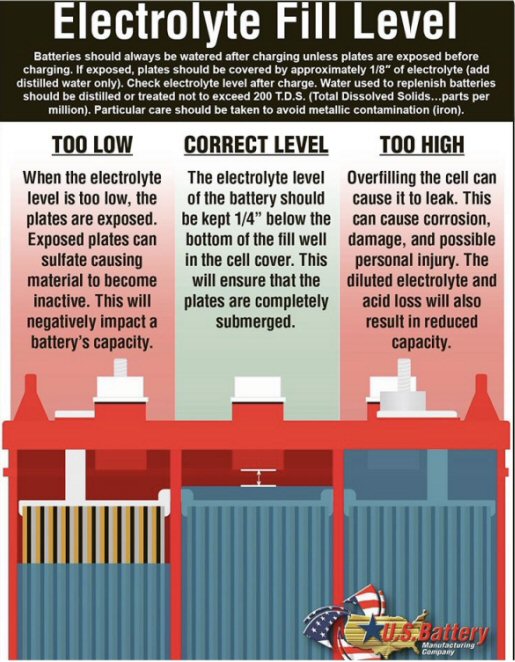
Pohle NV Center has available a single point battery filling system which makes the process of filling easier. (approx. $200)
A full 3 1/2 minute video on battery filling and maintenance here from US Battery:
http://usbattery.com/info-center/videos/
Picture of Battery Filler Instructions
1/14/2020
Amp-hours:
To quantify usage, automobiles have odometers, boats and bulldozers have hour-meters.

Modern golf cars have an electronic controller on-board tracking the electrical amp-hours consumed during usage. Amp-hours indicate that electricity is flowing and the car is moving. This is a direct parallel to odometers or hour-meters.

We at Pohle NV Center have decided to publish Amp-hours for each car to give you the very best indication of past usage for your peace of mind.

It is easy for someone to slap a new body on an old golf car and call it good. We hope all golf car dealers offer this same transparency in the years to come.

Amp-hours anecdotal guidelines:
100 amp-hours- Brand new car.

9,000 amp hours- Like new, maybe just used going to the mail box and back.

15,000 amp hours – Prime of life, get it before someone else does.

35,000 amp hours- Nice fleet rebuild, likely offering great value

50,000 amp hours - Getting up there, pretty well used car, better be a good
price. Need a look at the mechanical bits to make sure they are not worn out.

60,000 amp hours – This is a very well used car and it better be priced accordingly. Things are likely going to wear out and need to be replaced soon.
1/14/2020
E-Z-GO ELiTE Series vehicles are available with three different battery packs.

The 2.0 is a 60 amp-hour battery pack. The 2.0 pack offers roughly equivalent performance to traditional 12-volt lead acid battery packs and can offer even offer greater range over the 8-year warranty period as the lead acid batteries soon fade in capacity. Most golf courses and our customers choose these 2.0 packs.

The 3.0 pack at 90 amp-hours is recommended for those who want greater range than usual. The extra capacity is useful for folks driving to golf courses more distant from their home or driving in hilly terrain. Dynamic regenerative braking will recapture some of the energy spent climbing hills but having that extra capacity on-board can come in handy for a stop off at the clubhouse on the way home.

The 4.0 pack is rated for 120 amp-hours, suitable for folks who "have a long way to go and a short time to get there." This big pack is overkill for most of us but we are happy to order it up!

Happy Driving!

7/17/2019
Our Fleet Rebuilds are gone through tires-to-top.

We remove the old batteries and cables, apply an anti-acid bath to the battery compartment and repaint the frame as needed. We then install brand new batteries and cables and an anti-corrosion coating on all terminals.

As most Fleet cars are Almond, Green or Ivory, we often remove and replace the entire body with a new or repainted one to offer our customers a wide range of color options. The new factory bodies are, of course, excellent, and the repainted bodies are done locally by a superb automotive body shop and a guy who loves what he does. He custom mixes our special colors and applies a thicker layer of clear coat befitting golf car usage, even better and thicker than the factory. Incidental scratches can generally be buffed out for years to come.

We often install new wheels and tires – 12” or 14” wheel upgrades over the stock 8” wheels, as well as including DOT certified tires.

We also usually include automotive-grade custom seating and fabrics and a new, tinted, wrap-around windshield. If the color palette of the vehicle warrants it, we will swap the tan or white top for a new black one.

Most Fleet cars do not have lighting installed, so we add LED headlights, taillights and turn signals as well as a turn signal stalk, horn and state of charge meter. We do not piggy-back these 12V components off a single 12V battery. This poor practice causes charge and discharge imbalances and shortens battery pack life. Instead, we also install a proper 48V – 12V DC-DC Converter and power the 12V components from the Converter as the designers intended.

We do all that to the base car, and then get to work on options- pin striping, front accessory tray, rear seating (with heavy duty rear-springs included), coolers, club and ball washers, seat belts, and so on, as desired by the customer.
5/22/2019
Car rental is an option dependent on availability.
No reservations beyond seven days.
Please stop by to see if a golf car in our used or Fleet inventory would meet your needs.
5/22/2019
Fully charge batteries. Fill water to proper level after charge. DO NOT OVERFILL

Clean and dry batteries. Then spray protectant on all terminals to reduce corrosion

Every 30-45 days, the batteries should be charged a minimum of 8 hours (12 hrs if batteries are new) (Batteries slowly discharge in storage, particularly in hot weather) Water level should be checked at about the same interval (30-45 days)

FOR EZGO MODEL RXV WITH DELTA Q CHARGER:
We encourage users to leave the charger connected to the batteries and AC when storing. Once the charger completes to a solid green LED the charger will monitor the battery voltage. Lead acid batteries self-discharge over time and the self-discharge rate increases as batteries age. If the batteries self-discharge and the voltage falls below 2.08V per cell, the charger will restart and perform a charge cycle to top up the batteries.

If the voltage does not drop below 2.08V per cell (50.08V on a 48V system) and there is no activity or interruption to the charger"s AC or DC connections for 30 days, the charger will restart and perform a maintenance charge cycle. Each time a cycle is performed the 30-day timer is reset. This process will continue unless the charger enters an error code situation where the AC power may need to be cycled to clear the fault.

We strongly encourage users to check their batteries and charger periodically during the storage period to ensure the charge hasn"t entered a fault mode and to perform any battery maintenance that is required e.g. watering or cleaning terminals.
4/8/2019
Many 36V E-Z-GO golf cars have a vertical meter located to the right of the FNR toggle switch. This meter has 10 LED slots that light up RED one at a time. As the car discharges the reds light moves from F(full) towards E (empty)

When the car is 70% discharged the second light from the bottom starts flashing

When the car is 80% discharged the light at the bottom and second from the bottom alternate flashing

DURING RE-CHARGE THE LIGHTS DO NOT STEP BACK UP -- Only when the auto charger has run through its full cycle will the light reappear at F (full)

Sometimes this requires an extra charge to have the light move to F

See a picture of the indicator - http://www.pohlenv.com/Electric-Car-Care-Tips.aspx#ChargeIndicator
3/16/2018
E-Z-GO recommends that the battery state of charge be checked at least once every three months,
particularly at high temps above113 F.
At the high temps, the batteries are best stored at less than a full state of charge (ie: 75%) (do NOT store at a low state of charge ie: 15% or lower). To check the state of charge, turn the key switch to N and look at the meter on the dash. Do NOT leave the charger plugged into the car during long term storage.
The intent of the check up is to avoid damage by ensuring the battery never reaches a very low state of charge. The ELiTE lithium battery can sustain long term storage at high and low temperatures, in most cases better than the existing battery options.
2/24/2018
No, seat belts are not required on golf cars whether for street or golf course use.. Pohle NV Center offers retractable seat belts as an optional item.
Beginning in 2009, Maricopa County Sheriff"s Office installed seat belts on golf cars as a community service, but recalled them in 2018 in response to a golf car accident.
7/6/2017
Car should be charged after every 18 holes of golf or the equivalent (approx. 7 miles)

Check charger ammeter (the meter on the charger itself) OR light indicator to be sure charger has turned on

Charger will be hot to the touch during charging and may run for up to 18 hours before automatic shutoff

It is normal for wet lead acid batteries to gurgle or bubble during charging

7/6/2017
The answer depends upon your intended use and personal preferences. E-Z-GO produces an excellent electric and gas golf car. Cost of ownership is not significantly different between gas or electric golf cars.
Benefits of Electric
1. quiet
2. no fumes while driving
3. smooth acceleration
note: the new E-Z-GO ELiTE lithium battery golf car is lighter, more efficient, and no maintenance vs. wet lead acid batteries.

Benefits of Gas
1. greater range / distance (6 gal gas tank)
2. general familiarity with internal combustion engine vehicles
3. less hassle with long term storage (summertime for winter visitors)

Due to increasing environmental concerns and improved technology, electric golf cars are the most popular choice nationally, and used gas golf cars are becoming harder to find in the Valley of the Sun. However, gas cars remain the top choice for some applications. One of the main advantages of gas golf cars is much greater range. For farming and hunting use, this is a big advantage. For this reason, the "trail utility vehicle" category is one that sports a high percentage of gasoline engines.
Be sure to check on regulations in your area: some AZ communities do not allow gas golf cars on the golf course. Newer 4-cycle engines run cleaner and quieter than older 2-cycle engines that burn an oil and gas mixture.
The price of new electric and gas golf cars is very similar as is the cost of operation during the lifetime of the vehicle.
2/2/2017
Most modern automatic golf car chargers are turned on (activated) by the DC battery power instead of the AC wall power.

If the golf car has sat unattended for about 3 weeks or longer (or if there is a bad battery or corroded cable) the charger may not turn on when you plug it into the golf car.

Try plugging it in again. Check for loose or corroded cables. Check AC wall outlet or breaker to be sure that a breaker has not tripped in your home panel.

If the charger still will not turn on, it is necessary to get enough charge in the batteries to activate the charger. Charge the batteries individually with a 6V / 12V automotive charger, or Pohle NV Center will loan an old style 36V or 48V charger with timer. (it will activate from AC wall power instead of the DC battery power)
9/4/2015
Batteries should be kept free of dirt and corrosion to prevent excessive self discharge. Battery acid will stain a driveway, so wash batteries in an area where a stain won"t matter

It is best to use a mixture of baking soda and water. Cleaning your batteries once a month is a good practice.
Let the cleaner set for 5 to 10 minutes and rinse off with clean water. Be careful not to spray water directly into electrical components like your speed controller.

Placing an automotive drip tray or "Puddle Blocker" beneath the golf car will help prevent stains in the garage.
2/10/2015
The answer to this is more about laws, regulations and safety guidelines than it is about horsepower, gear ratio, and rpm.

The USA (ANSI)standards for a golf car used on a golf course is top speed of 12-14 mph.

The USA standards for a golf car (PTV) with lights, top, windshield, and mirror is top speed of 20 mph.

Arizona statute 28-101: ""Golf cart" means a motor vehicle that...has an unladen weight of less than 1800 pounds, that is designed to be and is operated at not more than 25 mph and that is designed to carry not more than four persons including the driver."

Also, in Arizona, if properly licensed, golf cars may be driven on public streets where the speed limit is 35 mph or less.

The USA standards for a low speed vehicle (LSV) ie: the E-Z-GO 2Five, is top speed 25 mph.

Be sure to test drive a golf car to feel its speed and acceleration before spending more dollars for greater top speed. It is very different from an automobile.
8/21/2014
Correct tire pressure allows the car to roll easier = longer battery life and easier steering

DOT street rated tires max. pressure = 35 psi. Turf tires max. pressure = 22 psi

(DOT = Department of Transportation)
8/12/2014
Clean Plexiglas windshield with a soft towel or chamois and water only. If necessary, use a mild soap. Plexiglas can scratch very easily. DON"T USE WINDEX OR ANY ALCOHOL/AMMONIA BASED WINDOW CLEANERS.

E-Z-GO Since 1954 · Made in USA Cushman American made for over 100 years Made in the USA Better Business Bureau Rating: A+